





Introduction
A sudden twist, fall, sports injury, or accidental impact can cause pain, swelling, and difficulty moving an affected body part. However, not every injury is the same. Sometimes, the problem is a sprain that affects the ligaments, while in other cases, it may be a fracture involving a broken bone.
Understanding the difference between a sprain and a fracture is important because both injuries can cause similar symptoms, but they may require different treatments. Ignoring a serious injury or continuing normal activities without proper assessment can delay recovery and lead to further complications.
At Kailash Hospital, Dhanbad, patients can seek orthopedic evaluation for bone, joint, and ligament injuries. Dr Ashish Bajaj, Consultant Orthopedic and Joint Replacement & Arthroscopy Specialist at Kailash Hospital, Dhanbad, provides orthopedic care for a range of musculoskeletal conditions.
This guide explains the symptoms, causes, differences, first aid, and recovery time associated with sprains and fractures, helping you understand when medical attention may be necessary.
Table of Contents
1. Understanding the Difference Between a Sprain and a Fracture
A sprain and a fracture are two different types of injuries that can occur after a fall, accident, or sudden movement.
What Is a Sprain?
A sprain occurs when a ligament is stretched or torn. Ligaments are strong bands of tissue that connect bones and help stabilize joints. Sprains commonly affect the ankle, wrist, knee, and thumb.
For example, twisting your ankle while walking on an uneven surface may stretch or tear the ligaments around the joint.
Sprains are generally classified into three grades:
- Grade 1 (Mild): The ligament is stretched, with minor damage and mild pain or swelling.
- Grade 2 (Moderate): The ligament is partially torn, causing more noticeable pain, swelling, and difficulty moving the joint.
- Grade 3 (Severe): The ligament is completely torn, potentially causing significant instability and difficulty using the affected joint.
What Is a Fracture?
A fracture is a partial or complete break in a bone. It can occur because of a fall, direct impact, road accident, sports injury, or weakened bones.
Fractures may be closed, where the skin remains intact, or open, where the broken bone is associated with an open wound. Some fractures are small cracks, while others involve multiple bone fragments or displacement.
Fractures usually require medical assessment to determine the type of injury and the most suitable treatment.
2. What Are the Common Symptoms of a Sprain?
Sprain symptoms vary depending on the severity of the ligament injury and the joint involved.
Common signs include:
- Pain around the joint: Pain may increase when moving, twisting, or putting pressure on the affected area.
- Swelling: The injured joint may become swollen shortly after the injury.
- Bruising: Discoloration can develop around the affected ligament.
- Limited movement: Bending or moving the joint may become uncomfortable.
- Tenderness: The area may hurt when touched or pressed.
- Joint instability: Severe sprains may make the joint feel weak or unstable.
A mild sprain may improve with appropriate care, but a severe sprain can cause substantial pain and difficulty walking or performing everyday activities.
Remember that these symptoms are not exclusive to sprains. A fracture can produce similar signs, so a proper examination may be necessary.
3. What Are the Warning Signs of a Fracture?
A fracture can affect movement and the normal function of the injured body part. Symptoms depend on the location and severity of the broken bone.
Important warning signs include:
- Severe or persistent pain: Pain may worsen with movement or pressure.
- Significant swelling and bruising: The affected area may swell quickly.
- Visible deformity: The injured limb may appear bent or out of its normal position.
- Difficulty bearing weight: Walking or standing may become difficult after a leg or foot injury.
- Restricted movement: Moving the injured area may be painful or impossible.
- Tenderness over a bone: Pain may be concentrated at a particular point on the bone.
- Open wound: A serious fracture may be associated with a wound through which bone is visible.
Not every fracture causes severe pain or an obvious deformity. Some small or stress fractures produce relatively mild symptoms initially.
Seek emergency medical care for an open fracture, major deformity, uncontrolled bleeding, or an injured limb that becomes numb, cold, pale, or blue. Do not attempt to straighten the bone yourself.
4. Sprain vs Fracture: What Are the Key Differences?
The main difference is the tissue affected: a sprain damages a ligament, whereas a fracture involves a break in a bone.
Here are 10 important differences to understand:
- Affected tissue: A sprain affects ligaments; a fracture affects bones.
- Common cause: Sprains often result from twisting a joint, while fractures may result from falls, direct impacts, or weakened bones.
- Pain location: Sprain pain is often around a joint; fracture pain may be concentrated over the injured bone.
- Swelling: Both injuries can cause swelling, so swelling alone cannot confirm the type of injury.
- Bruising: Bruising may occur with either a sprain or a fracture.
- Joint stability: A severe sprain may cause joint instability, while a fracture may affect the bone’s alignment and structural support.
- Movement: Both injuries can make movement difficult or painful.
- Diagnosis: A clinical examination helps assess both injuries; X-rays are commonly used to identify fractures.
- Treatment: Sprains may require protection, support, rehabilitation, and gradual movement. Fractures may need immobilization and sometimes surgery.
- Recovery: Recovery depends on the injury’s severity, location, treatment, and the individual’s health.
The important point is that symptoms overlap. You cannot reliably confirm a sprain or rule out a fracture based on pain or your ability to walk alone.
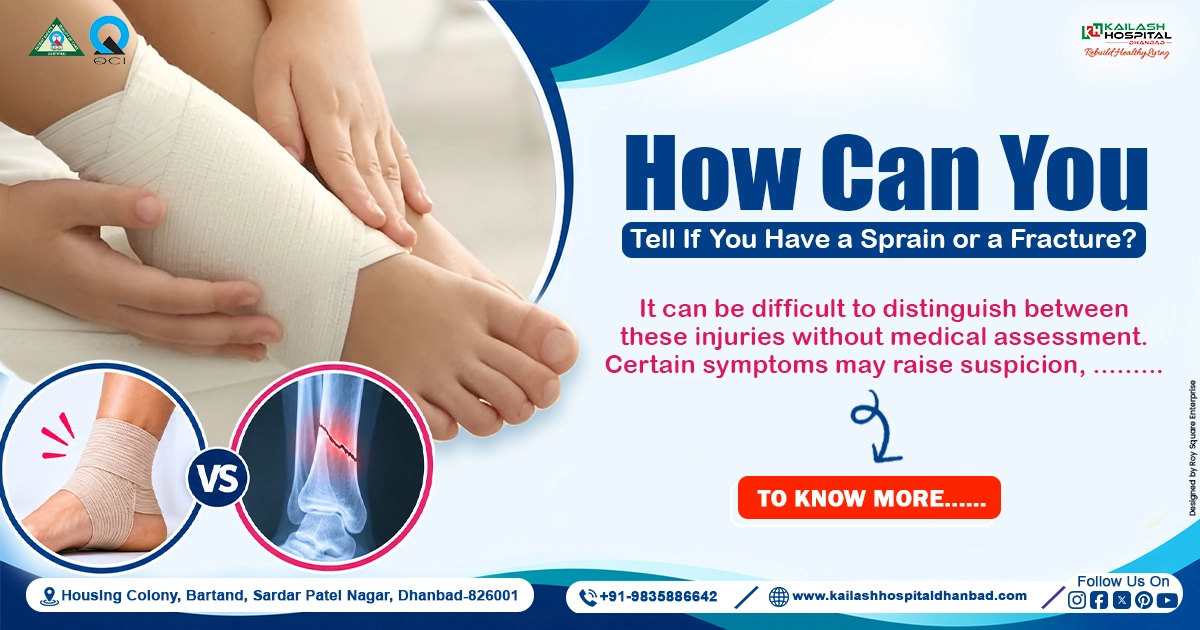
5. How Can You Tell If You Have a Sprain or a Fracture?
It can be difficult to distinguish between these injuries without medical assessment. Certain symptoms may raise suspicion, but no single sign can confirm the diagnosis.
Signs That May Suggest a Sprain
- Pain and swelling around a joint after twisting it.
- Tenderness around the ligament.
- Bruising and restricted joint movement.
- A feeling that the joint is unstable, particularly with a severe sprain.
Signs That May Suggest a Fracture
- Pain concentrated over a bone.
- A visible change in the shape of the injured area.
- Significant pain after a fall or direct impact.
- Difficulty using the affected limb or bearing weight.
- An open wound associated with the injury.
How Do Doctors Diagnose the Injury?
An orthopedic doctor may ask how the injury occurred, examine the affected area, and assess swelling, tenderness, circulation, and movement.
An X-ray is commonly used when a fracture is suspected. Depending on the injury, additional imaging, such as an MRI or CT scan, may be recommended.
Avoid repeatedly pressing, twisting, or testing an injured area to determine whether it is broken. If the injury causes significant pain or difficulty using the limb, seek medical assessment.
6. What Causes Sprains and Fractures?
Although both injuries can occur during everyday activities, their causes are not always the same.
Common Causes of Sprains
- Twisting an ankle while walking or running.
- Landing awkwardly after a jump.
- Sudden changes in direction during sports.
- Falling onto an outstretched hand.
- Overstretching a joint during physical activity.
- Accidental movements that place excessive force on a ligament.
Poor balance, inadequate conditioning, and a history of previous sprains may increase the risk of certain ligament injuries.
Common Causes of Fractures
- Falls at home, on stairs, or outdoors.
- Road traffic accidents.
- Sports-related collisions or direct impacts.
- Repetitive stress from activities such as running.
- Osteoporosis, which weakens bones and increases fracture risk.
- Minor trauma in people with certain conditions that weaken bone strength.
Maintaining bone health, improving balance, using suitable protective equipment, and following safe exercise practices can help reduce the risk of some injuries.
7. How Long Does It Take for a Sprain or Fracture to Heal?
Recovery time varies according to the severity of the injury, the body part involved, the treatment provided, and individual health factors.
Sprain Recovery Time
- Mild sprain: Often improves within a few days to a few weeks.
- Moderate sprain: May take several weeks or longer.
- Severe sprain: Can require several months of rehabilitation, particularly when the ligament is completely torn.
Returning to sports or strenuous activity too early may increase the risk of reinjury. Rehabilitation exercises can help restore strength, flexibility, balance, and joint stability.
Fracture Recovery Time
Many uncomplicated fractures take approximately 6–8 weeks to heal, although some heal sooner and others require several months.
The healing period depends on factors such as the bone involved, the fracture pattern, blood supply, age, smoking status, and underlying medical conditions.
Treatment may involve a splint, cast, brace, or surgery. Follow-up appointments help doctors assess healing and determine when weight-bearing or physical activity can safely increase.
Do not use pain reduction alone as proof that a fracture has healed. Follow your treating doctor’s instructions before returning to normal activities.
8. What First Aid Should You Provide for a Suspected Sprain or Fracture?
Correct first aid can help protect an injury until professional medical care is available.
First Aid for a Possible Sprain
- Protect the injured area: Stop the activity and avoid movements that worsen the pain.
- Rest the joint: Reduce pressure on the affected area.
- Apply a cold pack: Wrap ice or a cold pack in a towel and apply it for about 15–20 minutes at a time.
- Use gentle compression if appropriate: A supportive bandage may help control swelling, but it must not be tight enough to cause numbness or discoloration.
- Elevate the limb: If comfortable, raise the injured area to help reduce swelling.
Avoid placing ice directly on the skin. Seek medical assessment if the pain is severe, swelling is substantial, or you cannot use the joint normally.
First Aid for a Possible Fracture
- Keep the injured area still: Support it in the position found.
- Do not straighten the limb: Avoid attempting to realign a deformed bone.
- Control bleeding: For an open wound, apply gentle pressure around the wound with a clean dressing, but do not press directly on exposed bone.
- Avoid unnecessary movement: Do not ask the injured person to walk on a potentially fractured leg.
- Get medical help: Seek urgent assessment, especially after a significant accident or when warning signs are present.
Do not massage the injured area or try to push a visible bone back into place. If you suspect a serious fracture, prioritize emergency care over home treatment.
9. When Should You Consult an Orthopedic Doctor?
You should seek medical evaluation when an injury causes significant pain, swelling, bruising, or difficulty moving the affected body part.
Consult an orthopedic specialist if:
- You cannot bear weight after an ankle, foot, or leg injury.
- The pain is severe or continues to worsen.
- The injured area looks deformed.
- Swelling or bruising is substantial.
- You experience numbness, tingling, or unusual skin color.
- Symptoms do not improve as expected.
- You have repeated sprains or ongoing joint instability.
- You suspect a fracture following a fall, accident, or direct impact.
An open fracture, major deformity, uncontrolled bleeding, or signs of impaired circulation require emergency medical attention.
For orthopedic evaluation in Dhanbad, Dr Ashish Bajaj, Consultant Orthopedic and Joint Replacement & Arthroscopy Specialist at Kailash Hospital, Dhanbad, can assess musculoskeletal injuries and advise on appropriate treatment based on clinical findings.
Early diagnosis can help prevent complications, support proper healing, and guide a safe return to daily activities.
10. Why Choose Kailash Hospital, Dhanbad?
Choosing an appropriate healthcare facility is an important step when dealing with a suspected sprain, fracture, or other orthopedic injury.
Kailash Hospital, Dhanbad, is an option for patients seeking orthopedic consultation and guidance for bone, joint, and ligament conditions.
Patients can consider the hospital for:
- Orthopedic consultation: Assessment of pain, swelling, movement difficulties, and suspected injuries.
- Individualized treatment planning: Recommendations based on the diagnosis, severity, and patient-specific needs.
- Fracture care guidance: Advice on immobilization, follow-up, and recovery.
- Joint and ligament evaluation: Assessment of injuries that may affect stability and movement.
- Recovery guidance: Instructions for rehabilitation and returning to routine activities when medically appropriate.
Dr Ashish Bajaj, Consultant Orthopedic and Joint Replacement & Arthroscopy Specialist at Kailash Hospital, Dhanbad, can help patients understand their orthopedic condition and discuss suitable management options.
Patients should confirm the availability of specific diagnostic services, emergency facilities, and treatment options directly with the hospital before visiting.

11. Conclusion
Knowing the difference between a sprain and a fracture can help you respond appropriately after an injury. A sprain affects the ligaments that support a joint, while a fracture involves a broken bone. Both conditions can cause pain, swelling, bruising, and difficulty moving, making professional assessment important when the injury is significant.
Avoid ignoring persistent symptoms or returning to strenuous activity too soon. Appropriate first aid, accurate diagnosis, and a treatment plan tailored to the injury can support recovery and reduce the risk of complications.
If you experience a suspected fracture, severe sprain, or ongoing joint pain, consult an orthopedic specialist for guidance. At Kailash Hospital, Dhanbad, Dr Ashish Bajaj and the orthopedic care team can help patients understand their injury and the next steps toward recovery.
1. What is the main difference between a sprain and a fracture?
A sprain damages a ligament, while a fracture is a partial or complete break in a bone.
2. Can a sprain be as painful as a fracture?
Yes, a severe sprain can cause significant pain, and pain intensity alone cannot distinguish the two injuries.
3. Can you walk with a fracture?
Some people can walk with certain fractures, but walking does not rule out a broken bone.
4. Does every fracture require surgery?
No, many fractures heal with immobilization, while others require surgery depending on their type and severity.
5. Do you need an X-ray to diagnose a sprain?
Not always, but an X-ray may be needed to rule out a fracture when symptoms or examination findings raise concern.
6. How long does a mild sprain take to heal?
A mild sprain often improves within a few days to a few weeks, depending on the affected ligament.
7. How long does a fracture take to heal?
Many uncomplicated fractures take around 6–8 weeks, although recovery can take longer.
8. Should I apply ice to a sprain or fracture?
A wrapped cold pack may help reduce swelling, but it should not delay medical evaluation for a suspected fracture.
9. When should I see an orthopedic doctor after an injury?
Seek assessment for severe pain, significant swelling, deformity, difficulty bearing weight, or symptoms that fail to improve.
10. Who can I consult for orthopedic injuries in Dhanbad?
You can seek an orthopedic consultation with Dr Ashish Bajaj at Kailash Hospital, Dhanbad.