





When it comes to knee replacement surgery, patients often ask: is a robotic-assisted approach really better than conventional surgery? In this blog, we’ll explore everything—from symptoms and causes to myths and FAQs—to help you make an informed decision. Special mention goes to Dr. Ashish Bajaj, Consultant Orthopaedic at Kailash Hospital, Dhanbad, recognized as one of the best orthopaedic in Dhanbad, for guiding many patients through both robotic and traditional knee replacements.
1. What is Knee Replacement?
Knee replacement (also called knee arthroplasty) is a surgical procedure in which the damaged surfaces of the knee joint are removed and replaced with artificial components (metal, plastic) to relieve pain and restore function.
What is Traditional Knee Replacement Surgery?
In traditional knee replacement, a surgeon manually uses instruments to cut and remove damaged bone and cartilage, aligns the implant based on anatomical landmarks, and inserts the prosthesis. This approach has decades of experience and good long-term outcomes.
What is Robotic-Assisted Knee Replacement?
In robotic-assisted knee replacement, the surgeon uses a robotic system (or computer-assisted device) to assist in planning and executing the bone cuts, implant placement and soft tissue balancing with high precision. The robot does not operate independently: the surgeon guides and controls every step.
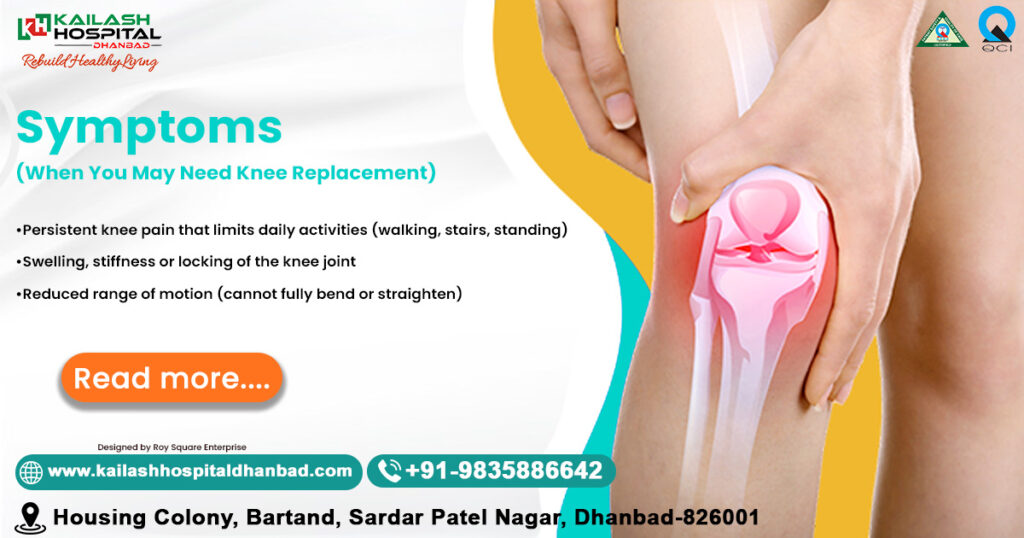
2. Symptoms (When You May Need Knee Replacement)
Here are common symptoms indicating that your knee joint is failing and you may be a candidate for replacement:
- Persistent knee pain that limits daily activities (walking, stairs, standing)
- Swelling, stiffness or locking of the knee joint
- Reduced range of motion (cannot fully bend or straighten)
- A feeling of instability or “giving way” in the knee
- Pain at rest (night pain) or fatigue in the leg
- Joint deformity (bow-legged or knock-kneed) or limping
- Non-response to conservative treatments (medication, physiotherapy)
If you are experiencing these symptoms, consult an orthopaedic specialist such as Dr. Ashish Bajaj at Kailash Hospital, Dhanbad for evaluation.
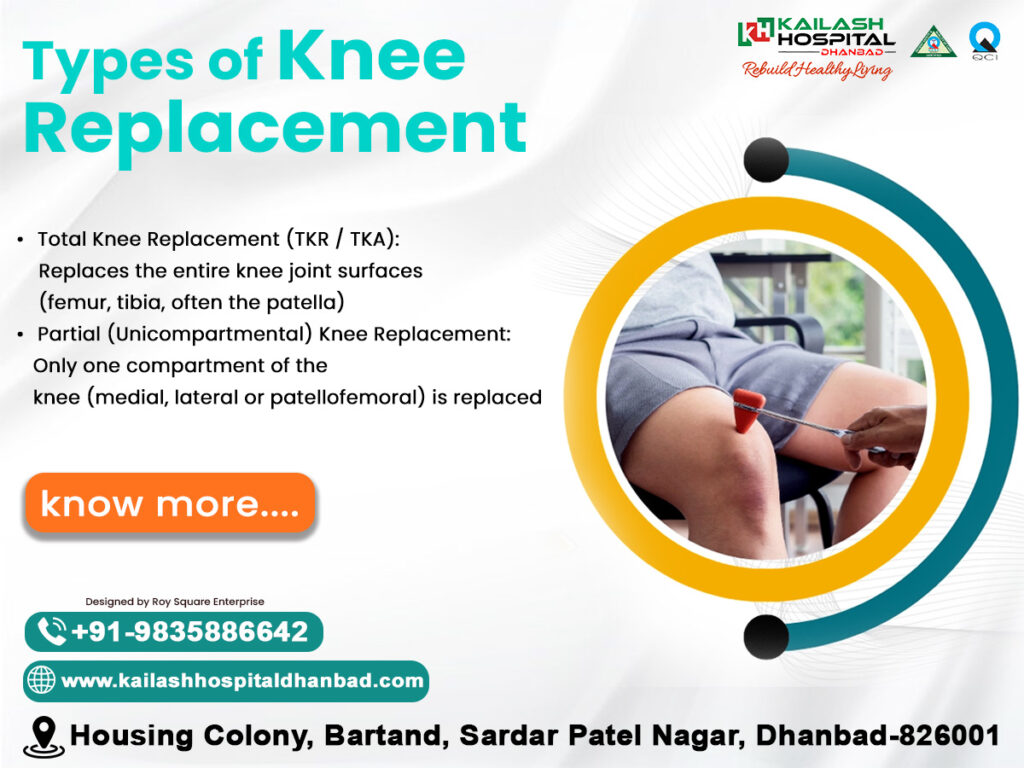
3. Types of Knee Replacement
Knee replacement can be classified based on the extent and type of surgery:
- Total Knee Replacement (TKR / TKA): Replaces the entire knee joint surfaces (femur, tibia, often the patella)
- Partial (Unicompartmental) Knee Replacement: Only one compartment of the knee (medial, lateral or patellofemoral) is replaced
- Revision Knee Replacement: Replacement of a previously implanted prosthesis due to wear, loosening or infection
In context of robotic-versus-traditional debate, both total and partial knee replacements may be performed either manually or with robotic assistance. Some meta-analyses show robotic-assisted unicompartmental knee arthroplasty offers better alignment results.
4. Causes of Knee Joint Failure (leading to replacement)
The reasons why knees deteriorate to the point of needing replacement include:
- Osteoarthritis (wear-and-tear arthritis): Most common cause in older adults
- Rheumatoid arthritis or other inflammatory arteriopathies
- Post-traumatic arthritis: Previous fracture or surgery in the knee
- Avascular necrosis / bone death
- Congenital or developmental deformities
- Infection in the knee joint
- Obesity / metabolic factors which increase load and accelerate degeneration
- Meniscal tears or ligament injuries that lead to joint instability and early wear
5. Risk Factors for Needing Knee Replacement
Key risk factors include:
- Age (older individuals)
- Weight / obesity (increased joint load)
- Previous knee injury or surgery
- Misalignment (bow-legged or knock-kneed)
- High physical demand / repetitive knee stress
- Genetics / family history of arthritis
- Inflammatory joint disease
- Smoking (impairs healing)
- Poor muscle strength / fitness around the knee
6. Diagnosis
When you consult an orthopaedic specialist (for instance Dr. Ashish Bajaj at Kailash Hospital, Dhanbad – one of the best orthopaedic in Dhanbad), the diagnostic process may include:
- Medical history and symptom review
- Physical examination (range of motion, stability, alignment, pain points)
- Imaging: X-rays (to show joint space narrowing, bone changes), CT or MRI if needed
- Laboratory tests if inflammatory or infectious cause suspected
- Pre-operative planning: For robotic surgery, often a CT scan or 3D imaging is used to map the knee anatomy and plan implant placement.
7. Treatment Options
Non-Surgical Options (Before Replacement)
- Weight management and lifestyle modification
- Physiotherapy (strengthening muscles around knee)
- Pain-relieving medication / anti-inflammatory drugs
- Joint injections (corticosteroids, hyaluronic acid)
- Bracing or assistive devices
when non-surgical treatments fail to relieve pain or restore function, knee replacement is considered.
Surgical Options – Traditional vs. Robotic
Traditional Knee Replacement Surgery: Manual bone cuts, surgeon-judged alignment and soft tissue balancing, implant insertion.
Robotic-Assisted Knee Replacement: Surgeon uses robotic or computer-assisted system to create a pre-operative 3D plan, precise cutting guides, implant placement and soft-tissue balancing aided by the robot. According to meta-analyses, robotic-assisted knee replacements offer better post‐operative alignment and mechanical restoration.
Decision Making – Which to Choose?
- The best method depends on patient anatomy, complexity of deformity, surgeon experience and hospital infrastructure.
- At a reputed center, Kailash Hospital, Dhanbad where Dr. Ashish Bajaj is practicing, you can discuss both options and choose what fits your case best.
- Robotic methods may cost more; require more advanced equipment and training.
8. Recovery
Recovery after knee replacement (whether robotic or traditional) involves:
- Early mobilization: most patients begin walking with assistance within 24 hours
- Physiotherapy: to restore motion, strength and function
- Pain control: medications, local blocks, ice, elevation
- Hospital stay: robotic-assisted may shorten stay and allow earlier home discharge.
- Gradual return to activities: within weeks–months (light activity)
- Full recovery: may take 3-6 months or more for certain functional outcomes
- Follow-up: monitoring for implant integrity, alignment, complications
In studies robotic knee replacement showed faster independent walking and higher patient satisfaction in early follow up.

9. Complications
As with any surgery, there are risks. They may vary slightly depending on method.
General complications (both methods):
- Infection (superficial or deep)
- Blood clots (DVT/PE)
- Bleeding or hematoma
- Nerve or blood vessel damage
- Implant loosening or wear over time
- Persistent pain or stiffness
- Poor alignment or instability
Specific considerations in robotic-assisted surgery:
- Longer operating time and higher cost.
- Pin-related fractures or pin‐track infection (used to fix robotic arm to bone)
- Learning curve for the surgeon and institution
- Equipment malfunction or need to convert to manual mid-surgery
Overall: while robotic shows better accuracy, functional clinical outcomes and complication rates may not differ significantly in all studies.
11. Top 10 FAQs
Here are common questions patients ask about robotic vs. traditional knee replacement:
- What makes robotic-assisted knee replacement different from traditional surgery?
- Robotic uses detailed 3D imaging and computer planning to enhance precision of bone cuts and implant placement; traditional relies on manual instruments and surgeon’s anatomical judgement.
- Am I a candidate for robotic knee replacement?
- If you’re eligible for knee replacement generally (severe arthritis, pain, dysfunction) you may be a candidate. Surgeon (for instance Dr. Ashish Bajaj at Kailash Hospital) will assess your anatomy, bone quality, deformity and overall health.
- Does robotic surgery guarantee a better outcome?
- Not a guarantee. Studies show better alignment and higher satisfaction, but some functional measures and long-term outcomes are similar between methods.
- Is the recovery faster with robotic knee replacement?
Many patients may experience faster discharge, quicker ambulation and less tissue trauma with robotic surgery.
- Is robotic knee replacement more expensive?
Yes, typically. The cost of equipment, planning and training is higher. A study noted robotic knee replacement improved outcomes but cost significantly more.
- Are the risks lower with robotic surgery?
- Some risks like mal-alignment may decrease, but other risks (pin-site fractures, longer operative time) can increase. Both procedures carry typical surgical risks.
- How long does the implant last in robotic vs. traditional surgery?
- Implant longevity depends on multiple factors: patient activity, weight, alignment, implant design. Robotic may improve alignment (which is good for longevity) but long-term data is still accumulating.
- Will I still need physiotherapy after robotic knee replacement?
- Yes. Rehabilitation is essential for function, strength and return to activities, regardless of method.
- Can every hospital perform robotic knee replacement?
- No. It requires specialized equipment, planning, surgeon training and infrastructure. It’s best to choose a centre experienced in robotic joint replacements — for example, Kailash Hospital, Dhanbad under Dr. Ashish Bajaj.
- How do I decide between robotic vs. traditional knee replacement?
- Discuss with your surgeon: your knee anatomy, deformity, bone quality, overall health, cost, hospital experience and your goals. Given the options, choose the method that offers the best balance of benefit, risk and cost for you.
12. Why Choose Kailash Hospital, Dhanbad?
When considering knee replacement, your choice of hospital and surgeon matters greatly. Here’s why you should consider Kailash Hospital, Dhanbad and Dr. Ashish Bajaj, Consultant Orthopaedic, one of the best orthopaedic in Dhanbad:
- Expert Consultant: Dr. Ashish Bajaj is a highly skilled consultant orthopaedic surgeon with experience in both traditional and robotic knee replacement procedures.
- Advanced Technology: The hospital is equipped to offer modern techniques and pre-operative planning (including robotics where applicable) for knee arthroplasty.
- Comprehensive Care: From diagnosis to pre-surgery evaluation, surgery, physiotherapy and follow-up – Kailash Hospital offers a full continuum of care.
- Patient-Centric Approach: The team takes time to explain all options (traditional vs. robotic), discuss cost-benefit, risks and expected outcome – enabling you to make a well-informed decision.
- Proven Outcomes: Patients in the Dhanbad region trust Kailash Hospital for orthopaedic excellence, and Dr. Ashish Bajaj is regarded as one of the best orthopaedic in Dhanbad for knee replacement.
- Local Access: For residents of Dhanbad and surrounding areas, opting for a specialist center, Kailash Hospital means reduced travel burden, closer post-op follow up and local rehabilitation support.
If you are exploring knee replacement options, a consultation with Dr. Ashish Bajaj at Kailash Hospital will allow you to understand whether robotic assistance is suitable for you, what the cost implications are, and what recovery path you can expect.
13. Conclusion
In the choice between robotic-assisted knee replacement and traditional surgery, there is no one-size-fits-all answer. The robotic approach brings enhanced precision, more accurate alignment, higher patient satisfaction, and sometimes faster recovery.
However, traditional knee replacement remains a deeply trusted, effective procedure with long-term success. The evidence suggests robotic may edge ahead in certain technical metrics (implant positioning, alignment) but the clinical functional differences are still modest in some cases.
Your best decision is made in collaboration with an experienced orthopaedic surgeon — such as Dr. Ashish Bajaj at Kailash Hospital, Dhanbad — who can evaluate your knee condition, overall health, lifestyle goals and budget, and then recommend the method that optimally balances outcomes and resources.
In summary: if you value state-of-the-art precision, are comfortable with the cost, and your anatomy is suitable, robotic-assisted knee replacement may offer advantages. On the other hand, if your anatomy is fairly standard, cost is a concern, and your surgeon is highly experienced with traditional methods, conventional knee replacement remains an excellent choice.
No matter which route you choose, diligent post-operative physiotherapy, weight management, and lifestyle modifications will play a critical role in achieving the best outcome.
— For expert guidance and to explore your options, contact Dr. Ashish Bajaj, Consultant Orthopaedic at Kailash Hospital, Dhanbad — one of the best orthopaedic in Dhanbad — today.